Let's dive straight into an idea I hold dear: if your motivation behind doing good is the applause, the rewards, the thrill of the spotlight that comes with being a "good Samaritan", then your intentions were never pure in the first place. I see this notion perfectly captured in what I consider to be 2015's standout anime: One Punch Man. It suggests, rather poignantly, that to do good for self-serving reasons is to taint the deed itself.
The majority would nod in agreement if asked whether giving up one's life to save another constitutes a "good" act. But let's add a layer of complexity to this question: what if you had to decide whose life to save?
Imagine you're faced with an unimaginable decision - whose life should be forfeited, your son's or your mother's? Which choice could possibly be the "good" one? Let's replace your mother with a police officer. Or a criminal. Now, which choice would be the "good" one?
Consider a scenario where you can ensure a prosperous, peaceful future for your grandchildren, but at the steep cost of condemning your son to a lifetime of hardship and disappointment. Would that be a "good" choice?
The argument that the concepts of good and evil can be boiled down to simple altruism fails to acknowledge a crucial complexity: it's impossible to prioritize everyone. Our capacity to serve is finite, so who should we choose?
To highlight this, consider this moral quandary: if forced to decide, would you send your son or a criminal to their doom? At first glance, the answer seems clear. But suppose you had foreknowledge that your son would become a murderer, and the criminal, if spared, would reform and save many lives. Would this shift your perspective, perhaps even alter your decision?
If we accept that choice is real and not a mere illusion, then it becomes our tool to shape the future. But, with the future shrouded in uncertainty, how can we label an action as "good" or "evil" when we can't foresee its ultimate consequence? Assisting an elderly person across the street appears benevolent–but if both of you are subsequently hit by a reckless driver, does the act maintain its virtue?
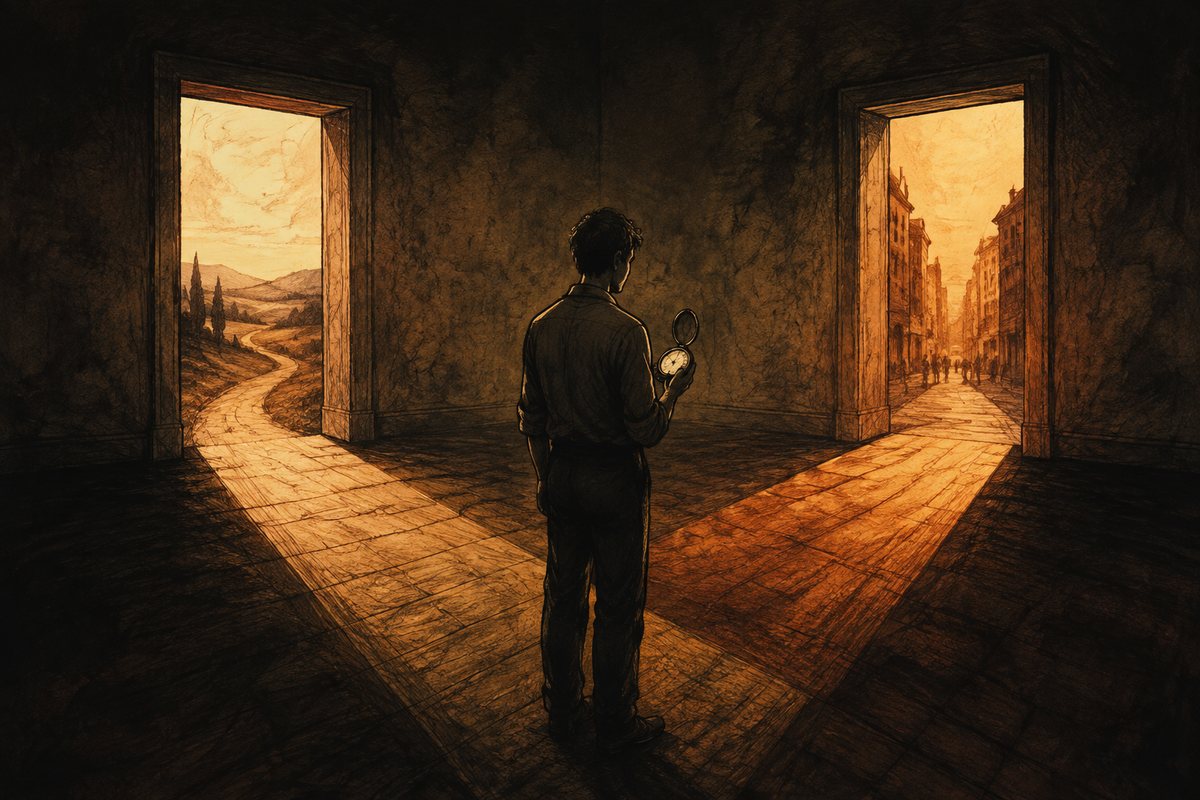
Consider this thought experiment: you've traveled back in time with the sole intention of eliminating Hitler before his monstrous crimes are committed. Upon arrival, you realize history never accounted for you, suggesting two potential realities: one, your actions don't alter the course of history, leaving Hitler to carry out his genocide; or two, your actions do indeed affect history, implying the future is malleable. After confirming your ability to interact with this world, you deduce your actions will indeed shape the future. So, do you still kill Hitler?
Pause before answering and consider this: at this point, he's yet to commit any atrocity. You're aware of his potential for evil, but to end his life now would be to condemn him for deeds yet uncommitted. Are you still prepared to proceed?
The adage warns against playing God, but if we reject determinism–if we embrace free will–it could be argued that we play God daily with our choices. Our actions are a drop in the pond, causing ripples that alter the course of countless lives and create unpredictable futures.
So here's the crux of my proposition: if "good" is equated with helping others, we can never conclusively know if we're doing good due to our inability to predict the ultimate outcome of our actions. We lack omniscience. Therefore, "good" actions must be informed by some external benchmark, like societal consensus or religious edicts. There's no universal definition of good because we lack the comprehensive perspective to establish one.
That leaves us pondering: what should good men do? The simple answer is this: do what you believe to be right, because that's all there is. There's a myriad of choices and none are inherently wrong. Those who choose inaction out of their belief in peace, like pacifists, aren't wrong. Those who take action and fight, like soldiers, aren't wrong either.
We'll all face the judgment of history, an entity we can't control. Our choices are invariably flawed, made with limited knowledge and thus heavily reliant on instincts and beliefs. Despite our noble intentions, we can still perpetrate harm. Labeling someone as "evil" is a precarious exercise, only possible with the benefit of hindsight, a lens that often casts a harsh light on us all.